
Do Ear Candles Work? An ENT Answers
Patients bring this one up every autumn, usually a little sheepishly. Someone's cousin swears by it, the box has a woodcut of a feather on it, and the photograph of the cut-open candle afterwards is genuinely persuasive. So let me answer it the way I'd answer it in clinic: ear candling does not do what it claims to do, the brown residue is not from your ear, and the complications I see from it are the kind that take months to undo.
What it claims to do
A hollow cone of waxed fabric goes in the ear canal. You light the far end. The warmth is said to create a gentle suction — a chimney effect — that draws wax, debris and, depending on who is selling it, "toxins" out of the ear and up into the cone. Ten minutes later you cut the stub open and find a dark, waxy deposit. Proof, apparently.
What actually happens
It was measured properly thirty years ago. A team at Spokane Ear, Nose and Throat published Ear Candles — Efficacy and Safety in The Laryngoscope in 1996. They burned candles in ear canals and in a model, and looked for the suction the whole premise depends on.
There wasn't any. No negative pressure was generated. No wax came out. And when they surveyed practising otolaryngologists, they found the practice had already caused injuries — burns being the commonest.
A later review in American Family Physician put it even more bluntly: the candles "neither created suction nor removed wax," and in people whose ear canals had been clean beforehand, they deposited candle wax in the canal. That is the opposite of the advertised effect. You can start with a clear ear and end up with an occluded one.
That brown residue is not your earwax
This is the part that convinces people, so it deserves a direct answer. Light one of these candles standing upright in a glass, with no ear anywhere near it, let it burn for ten minutes, and cut it open. You will find the same brown, waxy deposit.
It is candle wax and soot — the products of the candle burning itself. It looks like something came out of you because it is sitting at the bottom of a cone and because nobody expects melted beeswax to look like melted beeswax. The demonstration costs nothing and takes ten minutes, and I'd rather you ran it yourself than took my word for it.
The injuries are not hypothetical
In February 2010 the FDA issued a consumer warning telling people to stay away from ear candles, stating there is no valid scientific evidence for any medical benefit from their use. The harms it listed are specific: starting a fire; burns to the face, ear canal, eardrum and middle ear; injury from dripping wax; ears plugged by candle wax; bleeding; punctured eardrum. The same month it sent warning letters to three large manufacturers, and it has used import alerts, seizures and injunctions against others.
In the clinical literature the recurring three are candle wax occlusion of the canal, local burns, and tympanic membrane perforation.
The FDA also flagged something I think is underrated: delayed care. If candling is the thing you try for three months, the hearing loss or the infection or the lesion that was actually causing your symptoms goes three months unlooked-at. That delay does more harm than the candle, and it never shows up in anybody's injury statistics.
Health Canada went further than the FDA. Its position is that there is no scientific proof of benefit and plenty of proof of danger, that children are at higher risk, and that because no reasonable non-medical use exists, selling ear candles in Canada is illegal — including when they're sold "for entertainment purposes only."
What my own specialty says
The American Academy of Otolaryngology–Head and Neck Surgery Foundation's clinical practice guideline on cerumen impaction is explicit: candling has not been shown to be effective, it carries risk, and clinicians should discourage it.
The same guideline is just as firm about the thing most people do instead, which is worth saying in the same breath: do not put cotton swabs or small objects in the ear canal. Both habits come from the same instinct — that the ear is dirty and needs to be cleaned out — and that instinct is wrong. A healthy ear canal clears itself.
One more thing, since the box usually says "Hopi"
Many brands sell these as "Hopi ear candles," implying an ancient Native American practice. The Hopi Tribe has stated that ear candling has never been a Hopi practice and has formally asked the manufacturer using the name to stop. Whatever ear candling is, it is not that.
What to do instead
Most of the time, nothing. Earwax is supposed to be there — it is mildly acidic, slightly antibacterial, and it migrates out on its own carrying dust and dead skin with it. Wax that isn't blocking anything and isn't causing symptoms does not need removing, and the guideline says so: watchful waiting is a legitimate plan, because impactions often resolve by themselves.
When wax is causing trouble — muffled hearing, fullness, itch, a hearing aid whistling — there are three approaches with actual evidence behind them, and none has been shown to beat the others. A cerumenolytic, which is a softening agent put in the canal. Irrigation, with a syringe or an electronic irrigator. And manual removal by someone who can see what they're doing.
Softening is the one you can reasonably do at home, and it is the whole reason our drops exist. A few drops of plain oil over several nights softens a plug so it either works its way out or comes out far more easily and far less uncomfortably when someone does remove it. No oil dissolves wax, and none of the three is dramatically better than the others — the differences are smaller than people assume, and the choice is mostly about what you'd rather put in your ear.
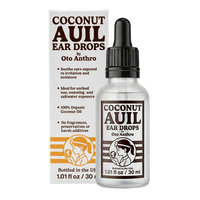
Auil Original is pharmaceutical-grade mineral oil: one ingredient, no scent, doesn't oxidize, the lowest allergenic potential of the three. It's the default for a reason. Olive Auil is for people who'd rather use a plant oil — slightly heavier, and it will eventually go rancid, so keep an eye on the date. Coconut Auil is fractionated coconut oil, which stays liquid in a cold bathroom and is more stable on the shelf than olive; it's the lighter-feeling of the two plant oils.
Whichever you use: tilt, five to ten drops, wait thirty seconds, sit up and wipe. Never push the pipette into the canal.
And please see someone rather than treating at home if you have ear pain, drainage, sudden or one-sided hearing loss, a known or suspected perforated eardrum, a history of ear surgery, diabetes, or you're immunocompromised or on anticoagulants. Those are the situations where the wrong home remedy does lasting damage, and they're exactly the situations where a candle is most tempting and least appropriate.

Questions I get asked
Is ear candling safe if someone else does it for me? No. The injuries in the literature are mostly from candling done by practitioners, not by people on their own. A second pair of hands does not change the physics, and it does not stop wax dripping.
But I felt something, and I could hear better afterwards. Lying still with your head on its side for fifteen minutes in a quiet room with warmth near your ear is a genuinely pleasant experience, and pressure sensations in the ear come and go on their own. That feeling is real. It just isn't evidence that wax moved.
What about the versions that say they're candle-free or use a filter? The claim is the same claim, and so is the evidence against it. If a product's mechanism is suction that was measured and found not to exist, changing the material doesn't rescue it.
My ear feels blocked right now — what should I do tonight? If there's no pain, no drainage and no sudden hearing loss, softening drops for a few nights is reasonable and often enough. If any of those three are present, or nothing has changed within a week or so, have it looked at rather than persisting at home.
Sources: Seely DR, Quigley SM, Langman AW. Ear candles — efficacy and safety. The Laryngoscope 1996;106(10):1226–9. U.S. Food and Drug Administration, consumer update, 18 February 2010. McCarter DF et al., American Family Physician, 15 May 2007. American Academy of Otolaryngology–Head and Neck Surgery Foundation, Clinical Practice Guideline (Update): Earwax (Cerumen Impaction), 2017. Health Canada consumer advisory.
For routine ear hygiene only. Not intended to diagnose, treat, cure or prevent any disease. Ask a doctor if you have concerns.
Honest Answers, By Electronic Post.
Do Ear Candles Work? An ENT Answers
Patients bring this one up every autumn, usually a little sheepishly. Someone's cousin swears by it, the box has a woodcut of a feather on it, and the photograph of the cut-open candle afterwards is genuinely persuasive. So let me answer it the way I'd answer it in clinic: ear candling does not do what it claims to do, the brown residue is not from your ear, and the complications I see from it are the kind that take months to undo.
What it claims to do
A hollow cone of waxed fabric goes in the ear canal. You light the far end. The warmth is said to create a gentle suction — a chimney effect — that draws wax, debris and, depending on who is selling it, "toxins" out of the ear and up into the cone. Ten minutes later you cut the stub open and find a dark, waxy deposit. Proof, apparently.
What actually happens
It was measured properly thirty years ago. A team at Spokane Ear, Nose and Throat published Ear Candles — Efficacy and Safety in The Laryngoscope in 1996. They burned candles in ear canals and in a model, and looked for the suction the whole premise depends on.
There wasn't any. No negative pressure was generated. No wax came out. And when they surveyed practising otolaryngologists, they found the practice had already caused injuries — burns being the commonest.
A later review in American Family Physician put it even more bluntly: the candles "neither created suction nor removed wax," and in people whose ear canals had been clean beforehand, they deposited candle wax in the canal. That is the opposite of the advertised effect. You can start with a clear ear and end up with an occluded one.
That brown residue is not your earwax
This is the part that convinces people, so it deserves a direct answer. Light one of these candles standing upright in a glass, with no ear anywhere near it, let it burn for ten minutes, and cut it open. You will find the same brown, waxy deposit.
It is candle wax and soot — the products of the candle burning itself. It looks like something came out of you because it is sitting at the bottom of a cone and because nobody expects melted beeswax to look like melted beeswax. The demonstration costs nothing and takes ten minutes, and I'd rather you ran it yourself than took my word for it.
The injuries are not hypothetical
In February 2010 the FDA issued a consumer warning telling people to stay away from ear candles, stating there is no valid scientific evidence for any medical benefit from their use. The harms it listed are specific: starting a fire; burns to the face, ear canal, eardrum and middle ear; injury from dripping wax; ears plugged by candle wax; bleeding; punctured eardrum. The same month it sent warning letters to three large manufacturers, and it has used import alerts, seizures and injunctions against others.
In the clinical literature the recurring three are candle wax occlusion of the canal, local burns, and tympanic membrane perforation.
The FDA also flagged something I think is underrated: delayed care. If candling is the thing you try for three months, the hearing loss or the infection or the lesion that was actually causing your symptoms goes three months unlooked-at. That delay does more harm than the candle, and it never shows up in anybody's injury statistics.
Health Canada went further than the FDA. Its position is that there is no scientific proof of benefit and plenty of proof of danger, that children are at higher risk, and that because no reasonable non-medical use exists, selling ear candles in Canada is illegal — including when they're sold "for entertainment purposes only."
What my own specialty says
The American Academy of Otolaryngology–Head and Neck Surgery Foundation's clinical practice guideline on cerumen impaction is explicit: candling has not been shown to be effective, it carries risk, and clinicians should discourage it.
The same guideline is just as firm about the thing most people do instead, which is worth saying in the same breath: do not put cotton swabs or small objects in the ear canal. Both habits come from the same instinct — that the ear is dirty and needs to be cleaned out — and that instinct is wrong. A healthy ear canal clears itself.
One more thing, since the box usually says "Hopi"
Many brands sell these as "Hopi ear candles," implying an ancient Native American practice. The Hopi Tribe has stated that ear candling has never been a Hopi practice and has formally asked the manufacturer using the name to stop. Whatever ear candling is, it is not that.
What to do instead
Most of the time, nothing. Earwax is supposed to be there — it is mildly acidic, slightly antibacterial, and it migrates out on its own carrying dust and dead skin with it. Wax that isn't blocking anything and isn't causing symptoms does not need removing, and the guideline says so: watchful waiting is a legitimate plan, because impactions often resolve by themselves.
When wax is causing trouble — muffled hearing, fullness, itch, a hearing aid whistling — there are three approaches with actual evidence behind them, and none has been shown to beat the others. A cerumenolytic, which is a softening agent put in the canal. Irrigation, with a syringe or an electronic irrigator. And manual removal by someone who can see what they're doing.
Softening is the one you can reasonably do at home, and it is the whole reason our drops exist. A few drops of plain oil over several nights softens a plug so it either works its way out or comes out far more easily and far less uncomfortably when someone does remove it. No oil dissolves wax, and none of the three is dramatically better than the others — the differences are smaller than people assume, and the choice is mostly about what you'd rather put in your ear.
Auil Original is pharmaceutical-grade mineral oil: one ingredient, no scent, doesn't oxidize, the lowest allergenic potential of the three. It's the default for a reason. Olive Auil is for people who'd rather use a plant oil — slightly heavier, and it will eventually go rancid, so keep an eye on the date. Coconut Auil is fractionated coconut oil, which stays liquid in a cold bathroom and is more stable on the shelf than olive; it's the lighter-feeling of the two plant oils.
Whichever you use: tilt, five to ten drops, wait thirty seconds, sit up and wipe. Never push the pipette into the canal.
And please see someone rather than treating at home if you have ear pain, drainage, sudden or one-sided hearing loss, a known or suspected perforated eardrum, a history of ear surgery, diabetes, or you're immunocompromised or on anticoagulants. Those are the situations where the wrong home remedy does lasting damage, and they're exactly the situations where a candle is most tempting and least appropriate.
Questions I get asked
Is ear candling safe if someone else does it for me? No. The injuries in the literature are mostly from candling done by practitioners, not by people on their own. A second pair of hands does not change the physics, and it does not stop wax dripping.
But I felt something, and I could hear better afterwards. Lying still with your head on its side for fifteen minutes in a quiet room with warmth near your ear is a genuinely pleasant experience, and pressure sensations in the ear come and go on their own. That feeling is real. It just isn't evidence that wax moved.
What about the versions that say they're candle-free or use a filter? The claim is the same claim, and so is the evidence against it. If a product's mechanism is suction that was measured and found not to exist, changing the material doesn't rescue it.
My ear feels blocked right now — what should I do tonight? If there's no pain, no drainage and no sudden hearing loss, softening drops for a few nights is reasonable and often enough. If any of those three are present, or nothing has changed within a week or so, have it looked at rather than persisting at home.
Sources: Seely DR, Quigley SM, Langman AW. Ear candles — efficacy and safety. The Laryngoscope 1996;106(10):1226–9. U.S. Food and Drug Administration, consumer update, 18 February 2010. McCarter DF et al., American Family Physician, 15 May 2007. American Academy of Otolaryngology–Head and Neck Surgery Foundation, Clinical Practice Guideline (Update): Earwax (Cerumen Impaction), 2017. Health Canada consumer advisory.
For routine ear hygiene only. Not intended to diagnose, treat, cure or prevent any disease. Ask a doctor if you have concerns.